
Principal Researcher: Desmond J. Tobin PhD, MRIA, Full Professor of Dermatological Science.
Location: Charles Institute of Dermatology, School of Medicine, University College Dublin, Ireland.
Dear Hair Follicle Donor:
Thanks, you for your generosity for consenting to allow a few of your hair follicle grafts to be made available for our research programs here in UCD. This is a critical resource to help drive research discovery. As my late father used to ask me: Des, why if we can get humans to the moon, and perhaps soon to Mars, have we not yet grown hair on a bald man’s head?” A very straight-forward question you may ask – the answer alas, is anything but. For one, there are few laboratories, perhaps less than 10 globally, that are actually working in this area of skin science. My lab in the UCD Charles Institute is one of those places. To my consternation, yours truly is ranked #2 globally for expertise in the human hair follicle [https://scholargps.com/highly-rankedscholars?year=2025&ranking_duration=LIFETIME_ALL&specialty=Hair+follicle#2%20]
My lab has been involved in hair research for over 25 years looking at a) male pattern baldness, b)an immune-related hair loss called alopecia areata, as well as c) hair pigmentation. This research requires, in fact relies upon, access to small hair scalp samples from patients with hair loss or hair graying. I cannot understate how important it is for researchers to learn from human hair follicles,as data from laboratory models, most commonly mice, often do not translate to human-relevant discovery.
With your kindly-shared hair graft samples, a courier takes these directly from HRBR to our lab in nearby UCD, within a few hours so that they are still ‘alive’ and so suitable for our studies. We stimulate these hair follicles to grow in the test tube by adding different ingredients (see below).We also use your samples to train the next generation of researchers in art of hair follicle biology.
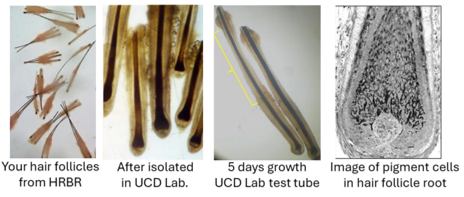
For example, over the last year, we have used your samples to learn more about how so-called oxidative stress (generated by free radicals, typically derived from unstable oxygen molecules) can damage hair follicle and especially their pigment-forming cells (called melanocytes), which may be associated with hair graying. With collaborators we seek to determine whether anti-oxidant nutritional supports could reduce this oxidative stress to support these pigment-forming cells while we age. We present our results at scientific conferences in Ireland and globally, with the aim that we published these results in scientific magazine for our colleagues to read and learn from.
Míle Buíochas – Many thanks – for helping with our research. This is very much appreciated!
Des Tobin PhD, MRIA.