
If you’re experiencing hair loss and don’t want a surgical treatment, Tricopat® is worth considering. It’s a non-invasive scalp therapy for men and women, built on patented technology that’s been clinically studied with the University of Bologna in Italy, and it’s now available at HRBR.
What Tricopat® Treats
Tricopat® is designed for two common patterns of hair loss:
- Androgenetic alopecia — the genetic, hormone-driven thinning most people think of as “male” or “female pattern” hair loss
- Telogen effluvium — diffuse shedding triggered by stress, illness, surgery, medication, rapid weight loss, or hormonal change
The treatment works through a multi-step protocol called TRICOGENESI®, which combines mechanical stimulation, pressure waves, micro-incisions, iontophoresis, LED light therapy, and growth-factor serums in a single session.
How Tricopat® Works
Each element of the treatment protocol plays a different role in improving scalp health and supporting hair follicles that have become miniaturised or dormant.
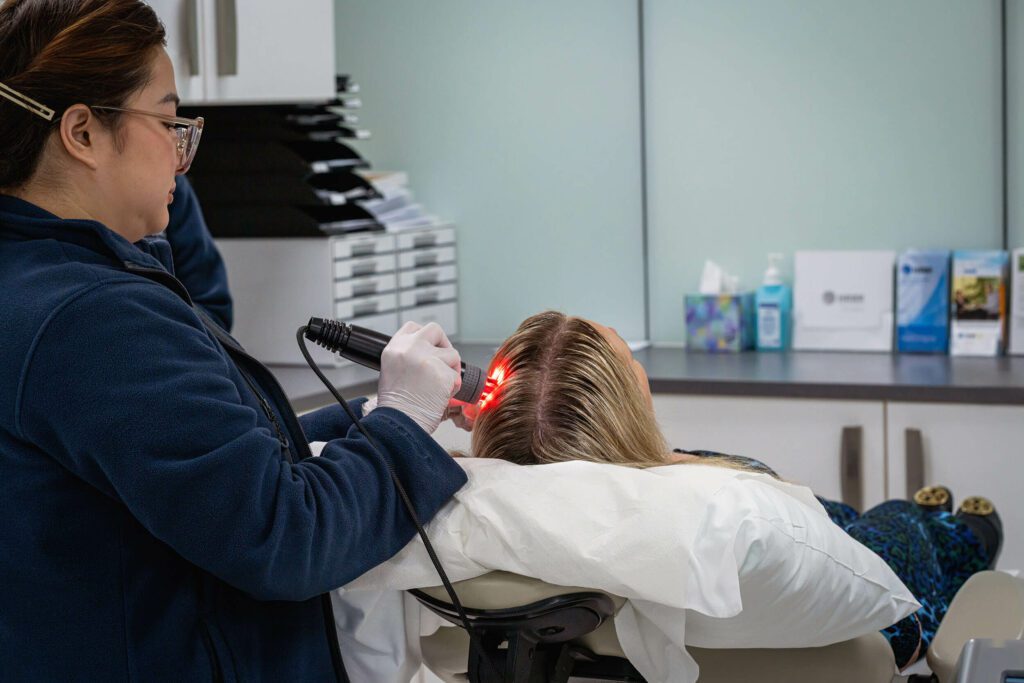
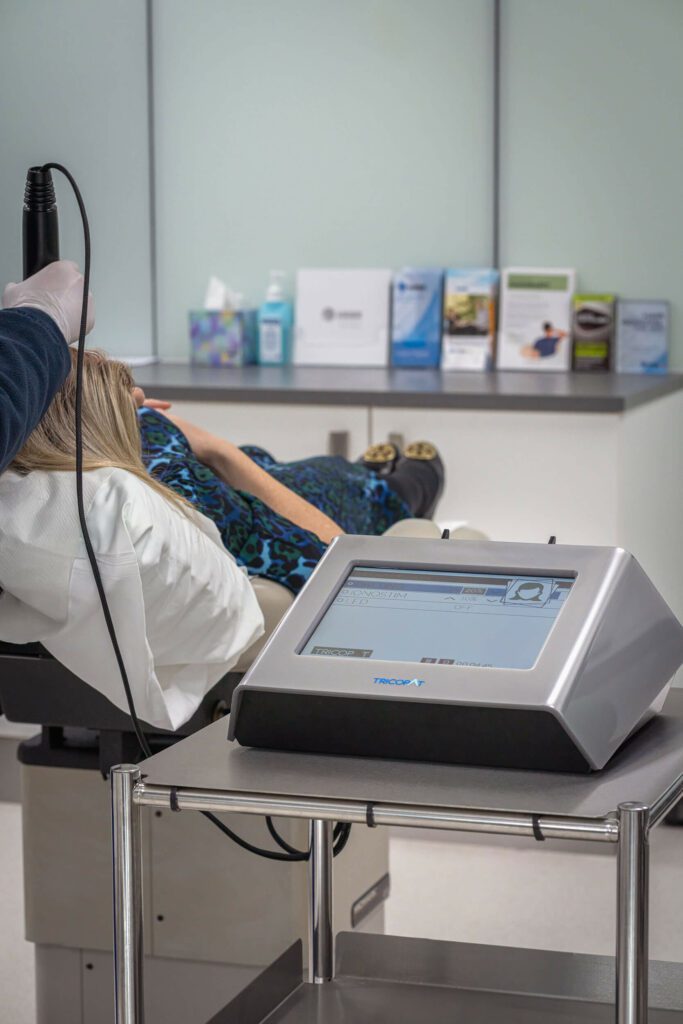
The Tricopat® device delivers rhythmic mechanical “patting” alongside shallow, controlled micro-incisions — just 0.25mm deep — to boost blood microcirculation and trigger the skin’s natural repair response. Outwardly spreading pressure waves increase oxygenation and circulation, helping deliver nutrients to the hair follicles. A mild electrical current (iontophoresis) then helps growth factors and peptides absorb into the scalp without disrupting the skin barrier, while red LED light stimulates cell activity in the tissue.
Together, these steps aim to extend the growth phase of the hair cycle, strengthen existing follicles, and support regrowth.
Clinical Evidence
In clinical evaluations of men and women with androgenetic alopecia and telogen effluvium, Tricopat® produced measurable increases in hair density and shaft thickness, alongside patients reporting a noticeable improvement in hair quality.
What a Session Involves
A typical Tricopat® session takes about 45 minutes and is comfortable — most patients describe it as relaxing rather than uncomfortable. There is no significant recovery time: you can wash your hair and get on with your day straight after.
Most treatment plans start with six monthly sessions, then move to maintenance visits every 3, 6, or 12 months depending on how your hair responds.
If you’ve looked into PRP and were put off by the idea of blood draws or injections, this is worth noting — Tricopat® involves neither, so there’s no bruising or swelling to plan around either.
Is Tricopat® Right for You?
Tricopat® tends to suit people who are:
- Experiencing diffuse shedding (telogen effluvium) linked to stress, illness, surgery, medication, weight loss, or hormonal changes
- Dealing with early to moderate male or female pattern hair loss
- Looking for a non-surgical option, or something to complement a treatment they’re already on
It isn’t suitable if you have an implanted electrical device such as a pacemaker, are pregnant, have metal cranial implants, or wear hair extensions. Side effects are uncommon — mild scalp sensitivity is the most you’re likely to notice.
Cost
A single Tricopat® session costs €300. You’ll also need a reusable treatment head (€100), which typically lasts around six sessions.
Talk to Us About Tricopat®
Tricopat® gives you a research-backed, non-surgical way to support your hair — without needles, downtime, or a long recovery. If you’d like to find out whether it’s a good fit for you, get in touch to arrange a consultation.
References:
1 Alessandrini AM, Bruni F, Piraccini BM, Starace M. The Effectiveness and Tolerability of Preformed Growth Factors Vehiculated Through Iontophoresis on Patients with Androgenetic Alopecia and Telogen Effluvium: A Clinical Study. Dermatol Pract Concept 2021; 159:2021082.
2 Vettorato E, Volonté P, Musazzi UM, et al. Skin microincision technique to enhance drug penetration for the treatment of keloid and hypertrophic scars. Int J Pharm 2025; 671. doi:10.1016/j.ijpharm.2025.125259.
3 Cedirian S, Pampaloni F, Quadrelli F, et al. Efficacy of Skin Patting and Iontophoresis with Dutasteride Gel in Male and Menopausal Female Androgenetic Alopecia: A Pilot Study. Dermatol Ther (Heidelb) 2025; 15:3419–24.
4 Hama S, Kimura Y, Mikami A, et al. Electric stimulus opens intercellular spaces in skin. J Biol Chem 2014; 289:2450–6.
5 Hasan M, Khatun A, Kogure K. Iontophoresis of Biological Macromolecular Drugs. Pharmaceutics 2022; 14. doi:10.3390/pharmaceutics14030525.
6 Kajimoto K, Yamamoto M, Watanabe M, et al. Noninvasive and persistent transfollicular drug delivery system using a combination of liposomes and iontophoresis. Int J Pharm 2011; 403:57–65.
7 Umino Y, Denda M. Effect of red light on epidermal proliferation and mitochondrial activity. Ski Res Technol 2023; 29:1–6.
8 Starace M, Cedirian S, Quadrelli F, Piraccini BM. Iontophoresis as a potential treatment for alopecia areata incognita. Ital J Dermatology Venereol 2024; 159:1–2.
About the Author

Dr Dmitri Wall
Medical Director, Consultant Dermatologist and Hair Transplant Surgeon
MB BCh BAO RCP
Dr Dmitri Wall is Medical Director at Hair Restoration Blackrock, a consultant Dermatologist, Hair Transplant Surgeon (International Society of Hair Restoration Surgery member) and hair researcher. He has received internationally recognised subspecialist training in hair and scalp disorders, is an active publisher of research papers in international journals, and an Associate Professor in the University College Dublin, School of Medicine.