

Female pattern hair loss is one of the most common reasons women attend HRBR as it is believed that over half of all women will suffer from it by the age of 80.[1,2]
As doctors who specialise in hair and scalp conditions, we understand that hair loss is not simply a cosmetic concern. It can be distressing and can affect confidence, self-image and day-to-day wellbeing.
At HRBR, our first priority is to make an accurate diagnosis and rule out any co-existing conditions that may also impact a patient’s hair.
While the cause of female pattern hair loss is unknown, it is believed that genetics, hormone, age and endocrine (hormonal factors) all play a role. While the role of stress and lifestyle is frequently debated, there is less research to confidently associate them with its progress.
What is female pattern hair loss?
Female pattern hair loss, also referred to as androgenetic alopecia (AGA), is a non-scarring form of hair loss. This means that the hairs produced by hair follicles, survive for shorter periods of time and become finer, shorter and lighter in colour over time. This typically occurs in a pattern that begins in the centre of the top of the scalp.
While the frontal hairline is usually preserved, the parting becomes wider and the scalp may become more visible through the hair. In some women, however, they may see more prominent temples and/or an emerging translucency affecting the centre of the frontal hairline.
Because of the shorter lifespan of affected hair, many women will notice increased shedding as the first sign of female pattern hair loss, followed by thinning, a reduction in volume, for example a thinner ponytail, and a shortening of the length they can grow their hair.
The Sinclair and Ludwig Scales
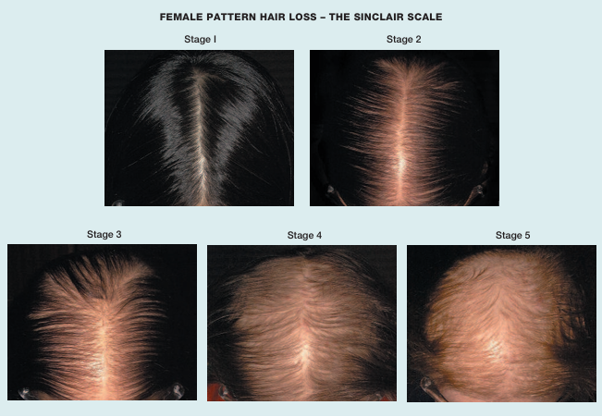
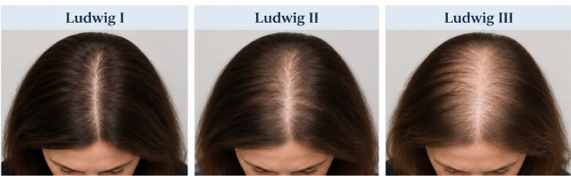
While a number of scales exist to grade severity of female pattern hair loss, the Sinclair (5 grades) and Ludwig (3 grades) scales are the most commonly used. Both scales look at thinning over the top and crown of the scalp. The scales are useful because they give the doctor and patient a shared language when discussing the extent of hair loss, importantly when used to monitor hair density over time, they allow visible and objective monitoring of change over time.
Sinclair Scale: a five-point scale used to grade the severity of female pattern hair loss by assessing the degree of central parting widening and thinning over the crown, from Grade 1, which represents normal hair density, to Grade 5, which represents advanced thinning with marked scalp visibility.
Ludwig Scale: a three-point scale used to describe progressive thinning over the top of the scalp, from Grade I, which represents mild thinning and widening of the parting, to Grade III, which represents advanced thinning with significant scalp visibility.
While both scales are helpful, they only form part of an assessment required to make a confident and complete diagnosis.
They do not by themselves diagnose the cause of hair loss. Two women may appear to have a similar degree of thinning but require very different treatment depending on the cause of hair loss. At HRBR, we use the pattern of hair loss alongside the medical history, scalp examination with trichoscopy and any necessary investigations, such as laboratory testing, and biopsy, to guide treatment.
What causes female pattern hair loss?
Female pattern hair loss is usually related to a combination of genetic and hormonal factors. It is inherited from both sides of the family. Hormonal influences in women are more complex than in male pattern hair loss and are still being researched. Many women with female pattern hair loss have normal hormone levels, but still gain benefit from the introduction of antiandrogen therapy that modifies a woman’s sensitivity to testosterone and other male-type hormones such as dihydrotestosterone (DHT), or alter their production.
Female pattern hair loss can begin at different ages, but it is more commonly noticed from middle age onwards and may become more apparent after the menopause when hair character, such as lustre and colour loss can accentuate loss of density. Changes in oestrogen levels, ageing and genetic susceptibility may all play a role. However, the pattern and rate of hair loss varies from person to person.
Not all hair loss in women is female pattern hair loss
There are many possible causes of hair loss in women. Some are temporary and reversible, while others need specialist medical treatment. For this reason, it is important not to assume that all thinning is female pattern hair loss.
- Telogen effluvium, which can occur after illness, surgery, high fever, childbirth, major stress, crash dieting or some medications. More recently we have seen this emerge with patients following the introduction of GLP-1 agonists. It is not yet understood whether this is a direct effect of medication, or, the impact of the weight loss they induce.
- Dermatological scalp conditions such as alopecia areata, frontal fibrosing alopecia and lichen planopilaris.
- Traction alopecia, caused by repeated pulling on the hair from tight hairstyles or extensions.
- Hair loss related to scarring from accident, injury, burns or surgery.
Symptoms such as scalp redness, scaling, tenderness, burning, itching, eyebrow loss, patchy hair loss or a changing hairline should be assessed by a doctor with experience in hair and scalp disease. They may suggest a condition other than straightforward female pattern hair loss. While characteristic of scarring hair loss, these conditions can occur without obvious symptoms and signs. As such an initial examination is always worthwhile to ensure a condition that results in permanent hair loss is not progressing silently, sometimes even partially camouflaged by successful treatment of female pattern hair loss.
How female pattern hair loss is assessed at HRBR
When a female patient attends HRBR with hair loss, we take a detailed medical history and examine the scalp generally and under magnification (trichoscopy). We will ask about the pattern and duration of hair loss, family history, medical conditions, medications, diet, hair care practices, pregnancy or menopause, and any symptoms affecting the scalp.
In more complex cases or where a scarring form of hair loss is suspected, a scalp biopsy may be required to support the diagnosis. Over the years, we have worked with other groups internationally to review particularly complicated presentations at a joint monthly international meeting, enabling access to multiple opinions of international experts.
Treatment options for female pattern hair loss
Treatment depends on the diagnosis, the extent of hair loss, the quality of the donor hair and the patient’s goals. Female pattern hair loss is usually gradual and may progress over time. Treatment is aimed at slowing progression, improving density where possible, and helping the patient make an informed decision about what is appropriate for them.
Medical treatment is often the first treatment option for women suffering from female pattern hair loss. Minoxidil is a commonly used treatment for female pattern hair loss and may help to slow shedding and improve hair density in some women. Other medical treatments such as antiandrogen medications may be recommended, depending on the patient’s circumstances, after an extensive discussion so that the potential benefits, limitations, monitoring requirements and side effects are understood.
Tricopat is a non-invasive, needle-free scalp therapy available at HRBR that may be considered as part of a non-surgical treatment plan for suitable patients with hair loss or thinning. It uses a multimodal approach designed to support the scalp environment and hair follicle function, and may be recommended alongside established medical treatments where appropriate. Learn more about Tripocat.
Hair transplantation can be very successful for our female patients with female pattern hair loss, depending on the pattern of loss and medical therapy to date. It can also be particularly helpful for restorative correction of hair loss due to scarring from accident, injury, burns or surgery.
Our clinicians continue to contribute to research and guidelines relating to hair loss, which often reflect both our experience and prompt constant innovation in the services we provide.
Our approach at HRBR
At HRBR, every patient is assessed by a qualified doctor. Our role is to explain the likely cause of the hair loss and outline the options available.
We recognise that female hair loss can be emotionally difficult. Patients often tell us that losing their hair can feel like losing part of their identity. Taking time to understand how the diagnosis, and the treatment choices available, personally affect each patient helps us guide them towards decisions that feel right for them.
References
- Wall D, Meah N, Fagan N, York K, Sinclair R. Advances in hair growth. Faculty reviews. 2022 Jan 12;11:1.
- Gan DCC, Sinclair RD: Prevalence of male and female pattern hair loss in Maryborough. J Investig Dermatol Symp Proc. 2005; 10(3): 184–9.
About the Author

Dr Dmitri Wall
Medical Director, Consultant Dermatologist and Hair Transplant Surgeon
MB BCh BAO RCP
Dr Dmitri Wall is Medical Director at Hair Restoration Blackrock, a consultant Dermatologist, Hair Transplant Surgeon (International Society of Hair Restoration Surgery member) and hair researcher. He has received internationally recognised subspecialist training in hair and scalp disorders, is an active publisher of research papers in international journals, and an Associate Professor in the University College Dublin, School of Medicine.